KR
KR EN
EN ES
ES RU
RU JP
JP VN
VN
Dangun
Content
Dangun was the first king of the country Gojoseon, which was the first kingdom established in Korea. He founded Gojoseon and ruled the country for around 1,500 years. He is also known as "Dangun Wanggeom." "Dangun" means "the one who performs rituals," and "Wanggeom" means “the king who governs the country.” The oldest record of the Dangun story is found in Samguk Yusa. Samguk Yusa is a book written by the Monk Iryeon during the Goryeo Dynasty. The story of Dangun is also recorded in Jewang Ungi, a book written by Yi Seung-hyu during the Goryeo period.
Let's look at the Dangun story recorded in “Samguk Yusa”.
A long time ago, the king of the heavens, Hwanin, had a son named Hwanung. Hwanung wanted to help the human world. The king, Hwanin, gave Hwanung three treasures symbolizing the heavenly king: Cheon, Bu, and In, and instructed him to go down to Earth and govern the humans.
Hwanung descended to the top of Taebaeksan Mountain and established a city called Sinsi under the sacred tree called the "Sindansu," which was a mysterious tree. Sinsi means a sacred city. Hwanung, along with his ministers who controlled wind, rain, and clouds, governed the people.
At this time, a bear and a tiger came to Hwanung, wishing to become human. Hwanung gave them a bundle of mugwort and twenty garlic cloves, telling them to eat these and not see the sun for one hundred days in order to become human.
After 21 days (Samchilil), the bear turned into a woman, but the tiger, unable to endure the trial, could not become human. The bear-woman was called Ungnyeo.
Ungnyeo married Hwanung and gave birth to a son, who was Dangun Wanggeom.
Dangun established his kingdom in Pyeongyang in 2333 BCE and named it "Joseon."
Afterward, Dangun moved the capital to Baegaksan Mountain, Asadal, and ruled the country for 1,500 years. Later, Dangun became the mountain spirit of Asadal. He is said to have lived to be 1,908 years old.
Gojoseon means "Old Joseon," and this term was first used in Samguk Yusa. Later, to distinguish it from the Joseon Dynasty founded by King Taejo Yi Seong-gye, the name Gojoseon became widely used.
The traces of Gojoseon can be found through various artifacts. A famous bronze sword with a sharp blade and a bulging middle part is known as the "Bipa-shaped bronze sword," as it resembles the musical instrument "bipa." Additionally, the long-legged dolmen, which looks like a table, is also famous. Dolmen are large stone tombs, and you can see a large dolmen shaped like a table on Ganghwa Island. Clay vessels shaped like gourds, with handles on both sides, are also notable.
In Korea, we celebrate October 3rd, the day Dangun founded Gojoseon, as "Gaecheonjeol" (National Foundation Day). "Gaecheonjeol" means "the day the heavens opened" because Hwanung descended from the heavens. On this day, rituals are performed in honor of the heavens at Chamseongdan on Manisan Mountain in Ganghwa.
Gaecheonjeol is one of the national holidays celebrated along with Samiljeol (March 1st), Jeheonjeol (July 17th), Gwangbokjeol (August 15th), and Hangeulnal (October 9th).
Related Image
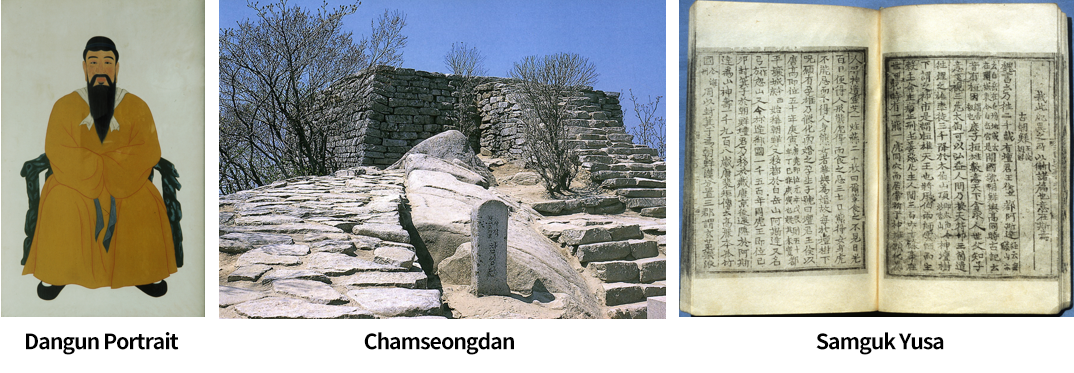
Source: Dangun Portrait, Encyclopedia of Korean National Culture
Source: Chamseongdan, Cultural Heritage Administration
Source: Samguk Yusa, Encyclopedia of Korean National Culture