KR
KR EN
EN ES
ES RU
RU
Yi Sun-sin
Content
Yi Sun-sin passed the military examination (Mugwa) at the age of over 30 in 1576, marking the start of his official career. However, his upright nature and refusal to compromise with injustice caused delays in his promotions and brought him many difficulties. In 1590, he was appointed as the Commander of the Left Naval District of Jeolla Province (Jeollajwa-do Sugun Jeoldosa) upon the recommendation of Yu Seong-ryong (1542-1607). During this time, Yi Sun-sin built the turtle ship (Geobukseon), trained his soldiers, and secured military supplies to prepare for war. Within a year, he created a powerful naval force. In the following year, 1592, the Imjin War began. The war, known as the Imjin Waeran, lasted for seven years, from 1592 to 1598.
Admiral Yi Sun-sin's naval forces achieved their first victory against the Japanese navy in the Battle of Okpo. Following this, he deployed the turtle ship (Geobukseon) for the first time in the Battle of Sacheon, where they destroyed enemy ships. He continued to secure victories in battles at Dangpo, Danghangpo, Busanpo, Hansando, and other engagements, successfully defending Joseon's seas.
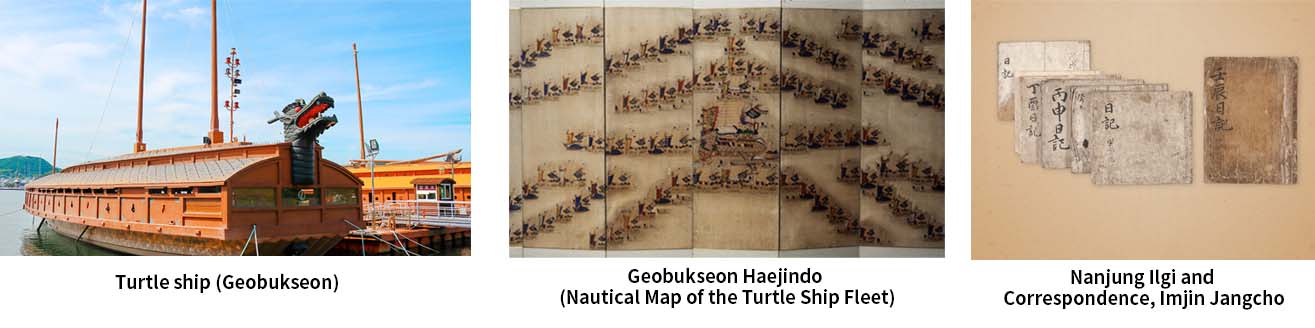
The Battle of Hansando was one of the most significant naval battles during the early stages of the Imjin War. It was a battle fought by luring the enemy out of narrow waters to the open sea in front of Hansando. Admiral Yi Sun-sin led the charge with the turtle ship (Geobukseon) and employed the "Crane Wing Formation" (Hakikjin) strategy, arranging his fleet in a formation resembling a crane spreading its wings to encircle and annihilate the Japanese navy. The Battle of Hansando is regarded as a decisive engagement that turned the tide of the Imjin War.
After achieving consecutive victories in various naval battles, Yi Sun-sin was recognized for his achievements and appointed as the Commander of the Three Provinces Navy (Samdo Sugun Tongjesa), overseeing the naval forces of Jeolla, Gyeongsang, and Chungcheong provinces. However, in 1597, he was falsely accused and imprisoned due to the schemes of Won Gyun (1540-597), who envied Yi's accomplishments, and a plot by the Japanese. Following this, Yi served as a regular soldier in white uniform without rank under General Kwon Yul.
That same year, Won Gyun, who had been appointed as the Samdo Sugun Tongjesa, suffered a devastating defeat at the Battle of Chilcheollyang, losing all ships and soldiers and dying in the battle. Yi Sun-sin was reinstated as the Commander of the Three Provinces Navy and achieved a monumental victory at the Battle of Myeongnyang.
The Battle of Myeongnyang is one of Admiral Yi Sun-sin's most iconic naval battles, alongside the Battle of Hansando. At the time, Joseon faced an unfavorable situation, with only 13 ships against over 130 Japanese vessels. Despite this disparity, Yi Sun-sin secured a major victory by using the strong currents of Uldolmok to restrict the enemy's movements. The Joseon navy defeated the Japanese forces by skillfully using the geographical characteristics of the area. Although it was a difficult battle by numbers, the strategic use of the environment and Yi Sun-sin's exceptional leadership turned the tide in favor of Joseon. The Battle of Myeongnyang is celebrated as a triumph of strategy and leadership against overwhelming odds.
In 1598, Admiral Yi Sun-sin died in action during the Battle of Noryang. From January 1592, when the Imjin War began, until shortly before his death in November 1598, he kept a diary, which is known as the Nanjung Ilgi (War Diary).
This diary was designated National Treasure No. 76 in 1962. Its uniqueness lies in being a firsthand account written by a commander who experienced and observed the war directly. Due to its historical value, the Nanjung Ilgi was inscribed on the UNESCO Memory of the World Register in 2013.
Admiral Yi Sun-sin fought against the Japanese forces in 23 battles, including the Battle of Hansando and the Battle of Myeongnyang, and won every single one. The turtle ship (Geobukseon) was a crucial factor behind these victories.
The turtle ship was a combat vessel primarily used by Admiral Yi during the Imjin War. It featured a dragon-head cannon at the front, capable of launching powerful attacks. Its deck was covered with sharp iron plates, preventing Japanese soldiers from boarding easily. The ship was also sturdily designed to withstand enemy arrows and bullets, making it an exceptional warship for its time.
Admiral Yi Sun-sin won every battle he personally commanded. He is revered as a hero who saved the nation during the Imjin War, and he is enshrined in places like Tongyeong Chungnyeolsa, Yeosu Chungminsa, and Asan Hyeonchungsa.
Numerous works of fiction, dramas, films, and musicals related to Admiral Yi Sun-sin continue to be produced and remain highly popular. Additionally, various regional festivals are held annually to honor him, such as the Asan Seongung Yi Sun-sin Festival, the Tongyeong Hansan Battle Festival, and the Yeosu Turtle Ship Festival.
Related Image
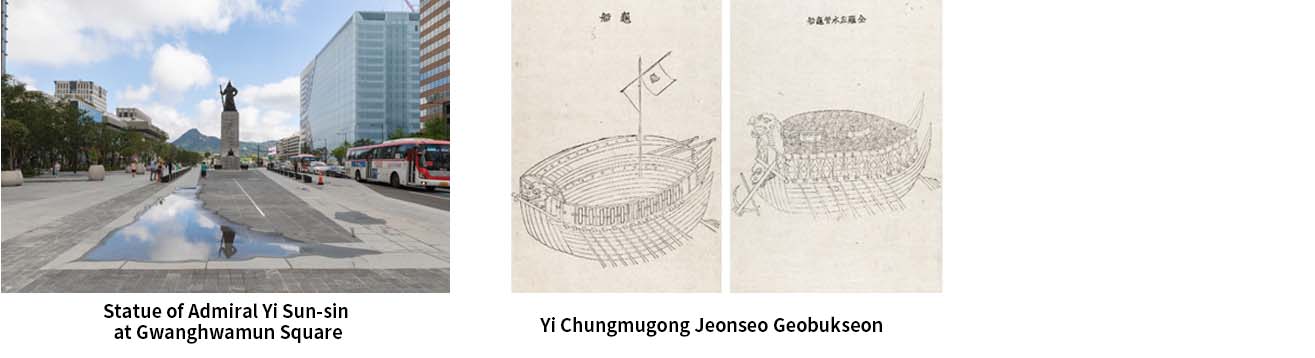
Source: Statue of Admiral Yi Sun-sin at Gwanghwamun Square, Modern History Archive
Source: Yi Chungmugong Jeonseo Geobukseon, Kyujanggak Institute for Korean Studies
Source: Turtle Ship (Geobukseon), Tongyeong Hansan Battle Cultural Foundation
Source: Nautical Map of the Turtle Ship Fleet (Geobukseon Haejindo), Encyclopedia of Korean National Culture
Source: National Treasure: Admiral Yi Sun-sin's Nanjung Ilgi and Correspondence, Imjin Jangcho, National Heritage Administration