KR
KR EN
EN ES
ES RU
RU
Jeong Yak-yong
Content
King Jeongjo, the reform-minded ruler of Joseon, highly valued Jeong Yak-yong's academic talents and practical abilities, and trusted him. Based on this, Jeong Yak-yong was able to deeply engage in the execution of Jeongjo's various reforms and policies. Jeong Yak-yong was not only interested in politics for the people but also had a keen interest in science, technology, and architecture. During his long exile, he wrote hundreds of books.
1. Jeong Yak-yong's Invention
• Crane-like device (Geojunggi): Jeong Yak-yong, under King Jeongjo's orders, participated in the construction of a fortress and introduced scientific methods. At the time, King Jeongjo wanted to move the tomb of Crown Prince Sado to the present-day Suwon, and he set up a large-scale plan to build a new fortress in Suwon by mobilizing national resources. Jeong Yak-yong researched efficient methods for stacking bricks during this construction and invented the geojunggi, a device used to lift and transport heavy stones. This invention helped shorten the construction period and reduce costs. These engineering innovations brought about progress in the construction of Suwon Hwaseong Fortress, becoming a turning point for the development of architectural technology in the Joseon Dynasty.
• Ferry Bridge (Baedari): After moving his father, Crown Prince Sado’s tomb to Suwon, King Jeongjo visited Hwaseong at least once every year. The biggest difficulty was crossing the Hangang River with a large number of people. In 1795, King Jeongjo planned a grand procession for the 61st birthday celebration of his mother, Queen Hyegyeonggung Hong, and instructed his officials to build a new ferry bridge to facilitate the crossing. Jeong Yak-yong and several other officials, under King Jeongjo's orders, completed the construction of this ferry bridge. They connected over 80 boats across the Hangang River and placed planks over them to create a temporary bridge. Records show that ferry bridges were installed before King Jeongjo’s time, but the only recorded image of a ferry bridge is the one built at Noryangjin to cross the Hangang River during King Jeongjo’s procession to Hwaseong. The appearance of this ferry bridge is detailed in the official records (Uigwe) of the Hwaseong procession for Queen Hyegyeonggung Hong’s birthday, titled 『Wonhaeng Eulmyo Jeongni Uigwe』, and in the painting of the procession, 『Hwaseong Neunghaeng Dobyeong』, which is a folding screen painting. These records are valuable resources that document the design and appearance of the ferry bridge constructed at the time.
2. Jeong Yak-yong's Works
Jeong Yak-yong not only had a deep interest in the new school of thought, Practical Learning (Silhak), but also in Western learning, which combined Catholic philosophy and Western science. At that time, the aristocracy disapproved of Catholicism because it rejected ancestral rites and advocated for equality among all people. As a result, Jeong Yak-yong faced criticism whenever Catholic-related incidents occurred. Nevertheless, his career in government remained stable until the death of King Jeongjo. When King Jeongjo passed away and King Sunjo ascended the throne, Jeong Yak-yong became involved in the persecution of Catholics and was exiled to Gangjin in South Jeolla Province. During his long 18-year exile in Gangjin, he devoted himself to academic research and used the opportunity to complete his work in practical learning. Based on his experience in government service and his extended exile, Jeong Yak-yong wrote more than 500 books, including 『Mongmin Simseo』, 『Gyeongse Yupyo』, and 『Heumheum Sinseo』.
『Mongmin Simseo』: 『Mongmin Simseo』 is a guidebook that tells local officials how to govern the people with the right attitude. It presents the moral discipline, administrative guidelines, governance strategies, and governing ideologies necessary for ruling a province. In this book, Jeong Yak-yong emphasizes that local officials should possess both competence and character. He particularly stresses that officials must be incorruptible, highlighting that they should never accept bribes, even if it is for the smallest item.
『Gyeongse Yupyo』: 『Gyeongse Yupyo』 is a book that outlines how to reform the system in order to make Joseon a prosperous nation. In this book, Jeong Yak-yong emphasizes the need to reform land policies, promote the development of cities and commerce, and advance technological capabilities. It can be seen as a comprehensive reform guide that consolidates what Jeong Yak-yong, both as a practical scholar and a government official, had observed and experienced.
『Heumheum Sinseo』: 『Heumheum Sinseo』 is a book related to crime that provides guidance on how to administer justice fairly when making judgments or imposing punishments. Matters related to punishment involve people's lives, yet there was a tendency to treat them lightly. To prevent the wrongful treatment of individuals, Jeong Yak-yong wrote about the points that officials in charge of such duties should be mindful of, as well as areas where the punishment system should be improved.
Jeong Yak-yong did not stop his academic passion even during his exile. Through practical research and writing, he sought to improve the lives of the people. His inventions and writings are regarded as important legacies that showcase the essence of practical learning in the late Joseon period, and they remain valuable resources for traditional Korean science and administrative reform thought. For these reasons, Jeong Yak-yong was selected as the first Korean to be named a UNESCO World Cultural Figure in 2012.
Related Image
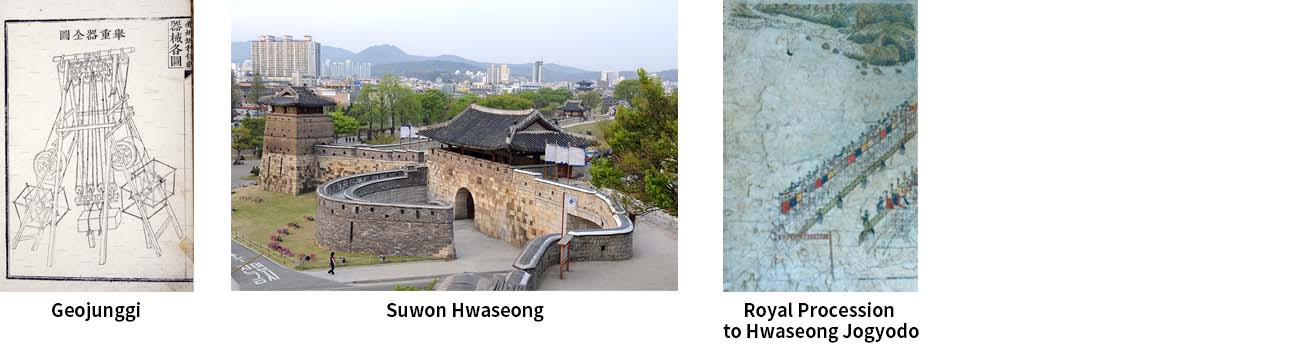
Source: Hwaseong Seongyeok Uigwe Geojunggi, Encyclopedia of Korean National Culture
Source: Hwaseomun Gate of Suwon Hwaseong Fortress, Suwon City Hall
Source: Royal Procession to Hwaseong Jogyodo, Encyclopedia of Korean National Culture