KR
KR EN
EN ES
ES RU
RU JP
JP VN
VN
Sewing
Content
Sewing was an important task in traditional Korean households and played a significant role in making essential items such as clothes, bedding, and embroidery. Beyond its practical purpose, sewing was regarded as a way to express beauty and infuse effort and love into the work. Traditional Korean sewing created a unique culture by using various techniques and tools to make and decorate clothes and accessories.
1. Sewing Tools
Various tools are used in sewing, and each tool has its own specific role. Traditional Korean sewing tools were designed for detailed work, and each tool has a unique shape suited to its function.
• Ruler: The ruler is used to measure length and accurately cut fabric. When sewing, the ruler plays an important role in measuring the length and width of the fabric to ensure it is cut evenly. Traditional Korean rulers are typically made from wood or bamboo and are characterized by their long and thin shape.
• Scissors: Scissors are the basic tool for cutting fabric and play a very important role in sewing. They are characterized by sharp blades and are designed to cut fabric smoothly and precisely. In traditional Korean sewing, the scissors' blades are particularly sharp and strong, allowing them to cut through multiple layers of fabric cleanly.
• Needle: The needle is a basic tool in sewing, used to stitch fabric together with thread. Needles come in various sizes and thicknesses, and the appropriate needle is selected based on the type and thickness of the fabric. In traditional Korean sewing, hand sewing was primarily used, and by adjusting the length and thickness of the needle, detailed work was made possible.
• Thread: Thread is the essential material needed to sew fabric together, and various colors of thread are used to match the fabric's color and pattern. The thread is chosen to harmonize with the fabric, and it also plays an important decorative role. Especially in embroidery, the color and thickness of the thread are crucial, and different threads are used to enhance the beauty of the work.
• Iron: The iron is a tool used to smooth wrinkles in fabric or press down sewn parts to make them flat. It is heated using fire. In traditional sewing, the iron was used to remove wrinkles from the fabric during cutting and to evenly shape the fabric during sewing. The iron was an important tool for completing the cutting and sewing processes.
• Steam Iron: The steam iron is a tool used to smooth out wrinkles in fabric and shape it after sewing. Traditionally, it was used along with the heated iron. Unlike modern irons, it was made of hot metal that pressed the fabric flat, playing an important role in the finishing process of the sewn parts.
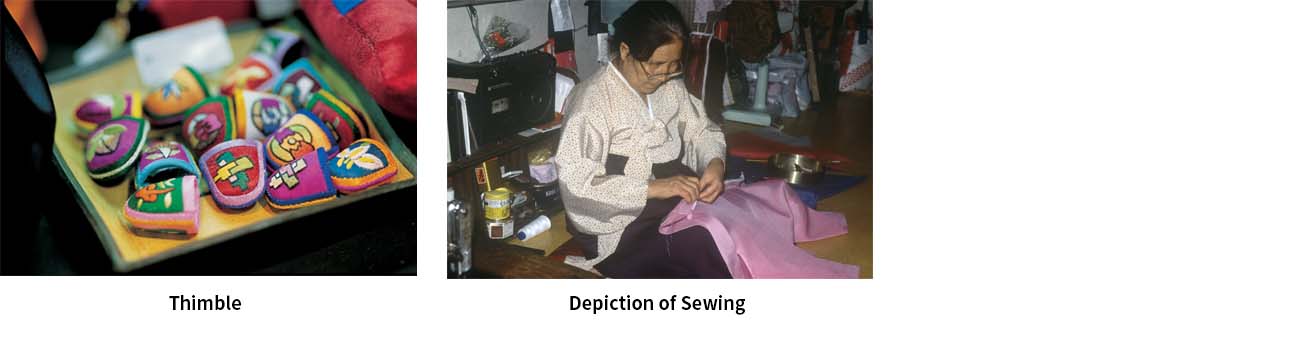
• Thimble: The thimble is a tool used to protect the fingers while sewing. It was worn on the fingertip, usually on the index finger, to prevent the finger from being pricked by the needle while pushing it through the fabric. Traditional Korean thimbles were mostly made of fabric or metal and were crafted to fit the size of the finger, making them convenient to use. Embroidery was sometimes added to thimbles to enhance their beauty.
2. Sewing Culture
In Korea, sewing was regarded as an important skill, going beyond just household chores. Women preparing for marriage learned to sew in order to make their dowry items, and they personally created the clothes, bedding, and decorative items needed for the household.
In this way, sewing holds practical value in everyday life while also possessing cultural significance and artistry, becoming an important element of Korean traditional culture. The items made through sewing carry meanings beyond mere household tools, and the care and skill involved in sewing are regarded as a precious cultural heritage, passing down traditional beauty and artistry to this day.
Related Image
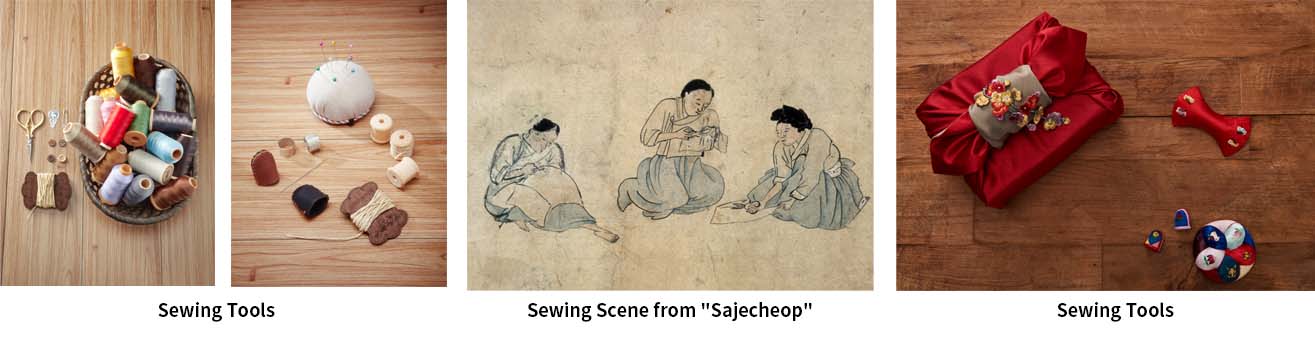
Source: Sewing Scene from "Sajecheop" by Jo Yeong-seok, Encyclopedia of Korean National Culture
Source: Depiction of Sewing, Encyclopedia of Korean National Culture